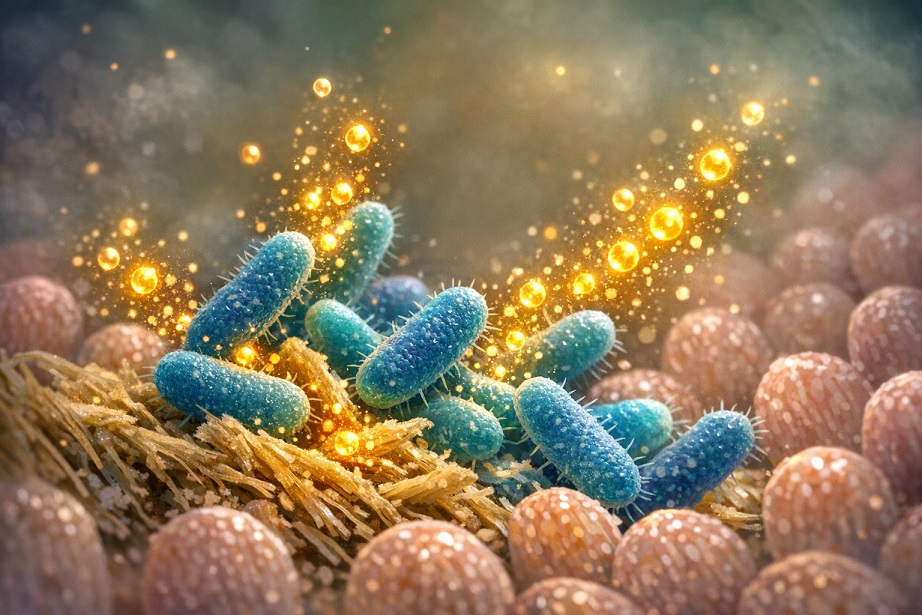
The phrase “feed your gut bacteria” has become common enough in health writing that it risks losing its meaning. It sounds like a metaphor, a pleasant way of saying that fiber is good for the gut, without implying anything particularly specific or consequential. But when the phrase is applied precisely to how Inulin-FOS prebiotics feed Bifidobacterium, it is not a metaphor at all. It is a description of a specific biochemical process with specific biological consequences that cascade from the colon through the immune system, the metabolic organs, and ultimately into the health of every system the gut influences.
The story of how prebiotics feed Bifidobacterium is the story of how a dietary supplement can initiate a biological chain reaction with effects that are disproportionate to the simplicity of the initial input. You are providing a structural carbohydrate to a bacterial genus. What follows from that provision is, by any reasonable assessment, remarkable.
The Feeding Mechanism: Selectivity at the Molecular Level
The feeding of Bifidobacterium by Inulin-FOS is not simply a matter of providing fermentable material to the colon generally. It is a selective process rooted in the specific molecular structure of the fiber and the specific enzymatic capabilities of Bifidobacterium that most other colonic bacteria do not share.
The Enzyme That Makes It Selective
Inulin-FOS consists of fructose units linked by beta-2,1 fructosidic bonds. These bonds are structurally distinct from the alpha bonds in digestible carbohydrates, and they require a specific enzyme, beta-fructosidase (also called inulinase), to cleave them. The human body does not produce this enzyme, which is why Inulin-FOS passes through the stomach and small intestine intact. In the colon, the vast majority of bacteria also lack or have minimal beta-fructosidase activity, meaning they cannot efficiently ferment Inulin-FOS as a primary energy source.
Bifidobacterium, however, carries well-developed beta-fructosidase enzyme systems encoded in gene clusters specifically dedicated to fructan utilization. These enzymes cleave the fructosidic bonds in Inulin-FOS extracellularly, releasing fructose fragments that Bifidobacterium then imports through dedicated ABC transport proteins for internal fermentation through its unique bifid shunt pathway. The entire apparatus, from the extracellular enzyme to the dedicated import system to the specialized metabolic pathway, is specifically built for fructan utilization in a way that few other colonic bacteria can match.
The result is that when Inulin-FOS is present in the colon, Bifidobacterium can exploit it as a rapid and reliable energy source while most other bacteria cannot. In the intensely competitive gut ecosystem, this selective nutritional advantage allows Bifidobacterium to multiply, expand its populations, and increase its ecological dominance in ways that would not occur if the available substrate were a less selective fermentable carbohydrate.

What Happens as Bifidobacterium Populations Grow
The expansion of Bifidobacterium populations in response to prebiotic feeding is not the end of the story. It is the beginning of a cascade of biological consequences that follows predictably from Bifidobacterium’s ecological dominance and metabolic activity.
The Chemical Environment Transforms
As Bifidobacterium expands, its fermentation activity intensifies proportionally. The primary fermentation products, lactic acid and acetic acid, are produced in increasing quantities, lowering colonic pH from the near-neutral range toward the more acidic conditions of 5.5 to 6.5 that characterize a healthy, Bifidobacterium-rich gut. This acidification is not just a chemical curiosity. It is one of the most consequential biological transformations in the gut ecosystem, because pH is the primary determinant of which bacteria can survive and thrive in the colonic environment.
Pathogens and opportunistic bacteria that were previously able to maintain populations in a near-neutral gut find themselves suppressed by the increasing acidity. Candida albicans, enterotoxigenic E. coli, Clostridium difficile, and Salmonella species are all significantly inhibited at the pH levels that Bifidobacterium dominance creates. The competitive exclusion that Bifidobacterium’s expanding populations exert, combining metabolic competition for substrate, physical occupation of mucosal adhesion sites, and chemical suppression through acid production, reshapes the gut ecosystem in a direction broadly hostile to pathogens and broadly favorable to the broader beneficial bacterial community that thrives alongside Bifidobacterium.
Short-Chain Fatty Acids Multiply
Simultaneously, Bifidobacterium fermentation of Inulin-FOS generates increasing quantities of short-chain fatty acids: butyrate, propionate, and acetate. Butyrate flows to the colonocytes that line the colon, fueling the tight junction maintenance and mucus production that constitute the gut barrier. A well-fueled gut barrier reduces the translocation of bacterial fragments and endotoxins into systemic circulation, lowering the background inflammatory state that drives a range of chronic disease conditions. Propionate travels to the liver, where it participates in metabolic regulation including glucose homeostasis and lipid synthesis modulation. Acetate enters systemic circulation, serving as an energy substrate and an immune signaling molecule with anti-inflammatory effects that extend from the gut to peripheral tissues throughout the body.
The Immune Transformation
Perhaps the most far-reaching consequence of well-supported Bifidobacterium populations is the effect on immune function. The gut hosts approximately 70 to 80 percent of the body’s immune tissue, and Bifidobacterium is one of this tissue’s most important microbial partners. As Bifidobacterium populations grow in response to prebiotic feeding, their interactions with gut-associated lymphoid tissue intensify, and the immune benefits that follow are measurable and documented.
Lymphocyte and Macrophage Activation
Bifidobacterium cell wall components interact with pattern recognition receptors on dendritic cells and macrophages in the gut immune tissue, promoting maturation and activation of these key immune cells. Research has demonstrated that Bifidobacterium fermentation activity promotes proliferation and activation of lymphocytes and macrophages, supporting both adaptive and innate immune responses. Butyrate produced by Bifidobacterium acts epigenetically on regulatory T cells, promoting immune tolerance maintenance and reducing excessive inflammatory responses.
These immune effects are not hypothetical associations. They manifest in documented downstream outcomes: higher vaccine antibody titers in individuals with greater Bifidobacterium abundance, lower rates of respiratory and gastrointestinal infection, more effective pathogen clearance, and reduced chronic inflammatory markers. The feeding of Bifidobacterium with prebiotic Inulin-FOS creates the conditions for all of these immune improvements by providing the bacterial populations whose metabolic and structural activities generate them.
The Nutritional Dimension
Growing Bifidobacterium populations also expand the nutritional synthesis and absorption-facilitating activities that this bacterial genus provides. More Bifidobacterium means more folate, riboflavin, biotin, and other B-vitamin synthesis within the gut. It means greater production of the lactic acid that creates the acidic environment in which calcium, magnesium, iron, and zinc are more efficiently ionized and absorbed. Human research has specifically confirmed that prebiotic Inulin-FOS supplementation improves calcium absorption, an effect sufficiently robust to produce measurable differences in bone mineral density with sustained use.
The cascade that begins with providing a structural carbohydrate to a specific bacterial genus, acidification, pathogen suppression, barrier support, immune calibration, B-vitamin synthesis, and mineral absorption facilitation, is not a collection of loosely related effects. It is a coherent biological story about what happens when the gut’s most consequential bacterial resident is given the nutritional conditions it needs to do what it evolved to do. Prebiotics feed Bifidobacterium. And that changes quite a lot.