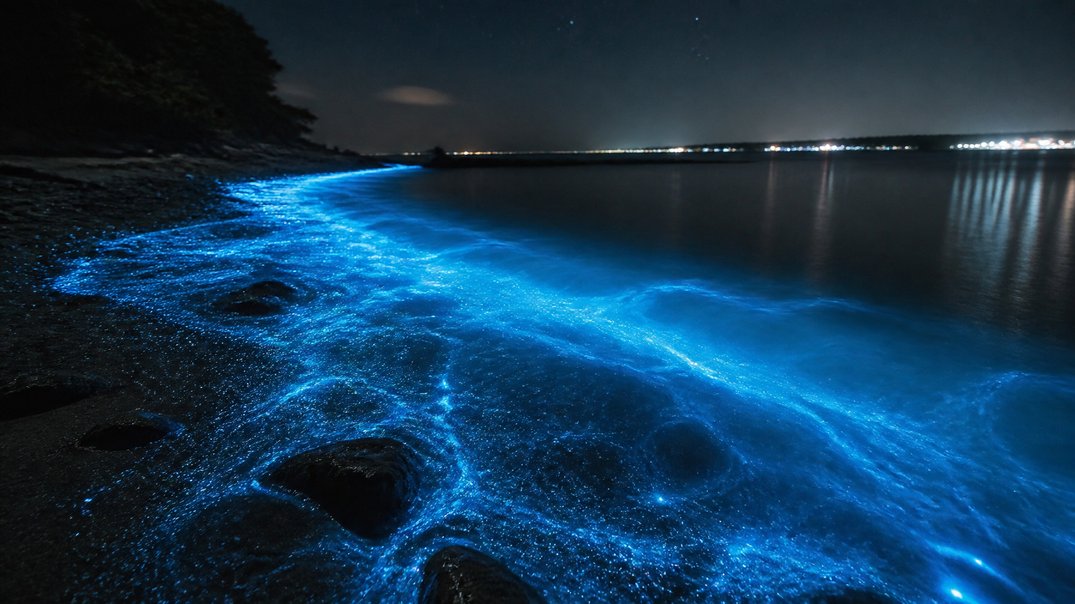
Video footage of ocean waves glowing bright blue at night circulates online every year, usually captioned as a bucket-list natural phenomenon somewhere off the coast of California or in a lagoon in Puerto Rico. The glow comes from bioluminescent algae, specifically a group called dinoflagellates, and it has nothing to do with the algae used to produce DHA and EPA in an omega-3 supplement. The two are entirely different organisms with different biology, different habitats, and, in some cases, opposite safety profiles.
What Actually Makes These Waves Glow
The blue glow comes from dinoflagellates, single-celled marine organisms that are technically classified as algae, though many species can also behave like tiny predators, consuming other microorganisms in addition to photosynthesizing. When physically disturbed, by a breaking wave, a swimmer’s movement, or footsteps in wet sand, certain dinoflagellate species emit a brief flash of blue-green light.
The Chemistry Behind the Glow
The light comes from a luciferin-luciferase reaction, the same general class of chemical process responsible for firefly light, though the specific molecules involved in dinoflagellates are distinct from those in insects. Inside the cell, a light-emitting compound called luciferin reacts with oxygen in a reaction catalyzed by the enzyme luciferase, releasing energy as visible light rather than heat.
Mechanical Stress Is the Trigger
Unlike bioluminescent organisms that glow continuously or in response to light exposure, these dinoflagellates specifically respond to physical, mechanical disturbance, which is why the glow appears concentrated along breaking wave crests and around anything moving through the water, rather than as a steady ambient light across the entire ocean surface.
Why Dinoflagellates Bother Glowing at All
The evolutionary purpose of this glow has been studied for decades, and the leading explanation involves predator defense rather than anything related to attracting food or mates.
A Startle Response Aimed at Predators
Researchers believe the flash of light functions primarily as a startle mechanism, designed to surprise or briefly disorient small predators that might otherwise eat the dinoflagellate, similar in concept to how some animals use a sudden flash of color or movement to deter an attacker.
A Strategy That Can Backfire
During large blooms, when dinoflagellate populations become dense enough to visibly discolor the water, this same defense mechanism can work against the organisms collectively. The combined light produced by trillions of individually flashing cells can act as a beacon, making it easier for larger predators to locate and track the dense patch of prey from a distance.

The Overlap with Red Tides
Bioluminescent dinoflagellates are closely associated with a phenomenon called red tide, though the two terms do not always refer to exactly the same event, and the overlap causes some understandable confusion.
Not Every Red Tide Glows, and Not Every Glow Is a Red Tide
Red tide refers to a visible discoloration of the water caused by a dense bloom of algae, which can appear reddish, brownish, or another color depending on the specific species involved. Only some red tide-forming species are bioluminescent, and the daytime discoloration people see is unrelated to the separate nighttime glow, which only appears when the cells are physically disturbed in the dark.
Some Blooming Species Are Genuinely Hazardous
This distinction matters because certain red tide dinoflagellate species produce toxins that can accumulate in shellfish and cause serious illness in people who eat them, while others are essentially harmless beyond the visual and occasional respiratory irritation some blooms cause nearby. The species responsible for the most famous glowing wave displays are generally not the same species responsible for the more dangerous shellfish toxin outbreaks, though both fall under the broad “red tide” label, which is part of why the phenomenon has a mixed reputation.
Where This Phenomenon Actually Occurs
Bioluminescent dinoflagellate displays are not evenly distributed across the world’s oceans, and their appearance depends heavily on local water conditions, nutrient availability, and water temperature.
Seasonal and Unpredictable Coastal Blooms
Along the coast of California, blooms of the bioluminescent species Lingulodinium polyedra have become a nearly annual occurrence in recent years, though the timing, intensity, and duration vary widely and are difficult to predict in advance. A particularly intense bloom recorded in 2020 was described by researchers as the strongest documented in the region since systematic plankton monitoring began around 1900.
Year-Round Bioluminescent Bays
A small number of locations, most famously several bays in Puerto Rico, maintain consistent, reliable bioluminescence throughout the year rather than depending on an unpredictable seasonal bloom, due to specific local water conditions that support a stable dinoflagellate population. These locations have become established ecotourism destinations specifically because visitors can reasonably expect to see the phenomenon on any given night, unlike the unpredictable blooms elsewhere.
Why This Is a Completely Different Category from Algae Oil
The algae used to produce DHA and EPA in omega-3 supplements, most commonly species like Schizochytrium, belong to an entirely different branch of the algae family tree than bioluminescent dinoflagellates, and the two have essentially nothing in common beyond both being broadly classified as algae.
Different Biology, Different Purpose
Schizochytrium is typically grown in enclosed, controlled fermentation systems specifically for its oil content, has no bioluminescent capability, and poses none of the toxin risks associated with certain red tide dinoflagellate species. It is selected and cultivated purely for its ability to accumulate high concentrations of DHA and EPA, a trait unrelated to anything involved in a dinoflagellate’s light-producing chemistry.
A Common but Understandable Mix-Up
Because both organisms fall under the broad, informal umbrella of “algae,” it is an easy leap to assume some connection exists between the glowing waves in a viral video and the oil inside an omega-3 softgel. Biologically, the two could hardly be more different, one is a fast-moving, light-emitting marine organism studied mainly for its role in ocean ecology and toxin research, and the other is a slow-growing, oil-rich microalgae cultivated in a bioreactor specifically for its fatty acid content.
Frequently Asked Questions
What Causes the Ocean to Glow Blue at Night?
The glow comes from bioluminescent dinoflagellates, single-celled marine algae that emit light through a luciferin-luciferase chemical reaction when physically disturbed by waves, movement, or contact.
Why Do Dinoflagellates Produce Light?
Researchers believe the light functions mainly as a startle defense against small predators, though during dense blooms this same mechanism can backfire by making the organisms more visible to larger predators tracking the light.
Is Bioluminescent Algae the Same as a Red Tide?
Not exactly. Red tide refers to a visible daytime discoloration caused by a dense algae bloom, and only some red tide-forming species are also bioluminescent at night, so the two phenomena overlap in some cases but are not identical.
Are Glowing Ocean Waves Dangerous to Swim In?
The species responsible for the most well-known glowing displays are generally not the same ones responsible for shellfish toxin outbreaks, though local health advisories should always be checked before swimming during any active bloom, since some species can cause mild skin or respiratory irritation.
Is Bioluminescent Algae Related to the Algae Used in Omega-3 Supplements?
No. Algae oil supplements use species like Schizochytrium, grown specifically for DHA and EPA content in controlled fermentation systems, which are biologically unrelated to the bioluminescent dinoflagellates responsible for glowing ocean waves.