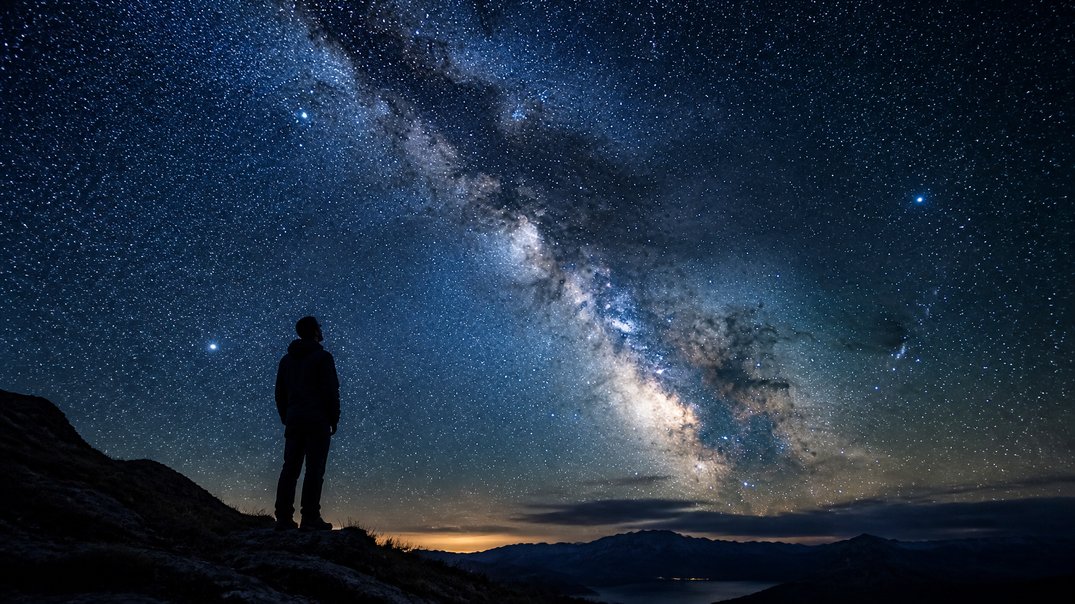
A clear night with a full moon overhead feels bright enough to walk by without a flashlight, casting visible shadows and making a landscape look almost silvery-blue. The actual amount of light involved is far smaller than this impression suggests, and the reason moonlight feels so usable despite being extraordinarily dim comes down to some genuinely interesting quirks in how the eye processes very low light levels, including an optical illusion so consistent that most people have experienced it without ever questioning why.
Just How Dim Is Moonlight, Really
Illumination is commonly measured in lux, and the numbers involved in moonlight are strikingly small compared with what people typically imagine. Full moonlight on a clear night delivers somewhere around 0.1 to 0.3 lux, while a moonless but clear starlit sky provides roughly 0.001 to 0.002 lux, a difference of about two orders of magnitude between the two darkest common nighttime lighting conditions. For comparison, typical indoor room lighting sits somewhere in the range of 100 to 500 lux, meaning even a bright full moon delivers something on the order of a thousand times less light than an ordinarily lit room. The moon itself is bright primarily by comparison with the overwhelming darkness surrounding it, not because it delivers a genuinely large quantity of light in any absolute sense.
Why the Eye Can Do So Much With So Little Light
Despite these minuscule light levels, human vision manages to extract a surprising amount of usable information under full moonlight, largely thanks to the rod photoreceptors, which are far more sensitive to light than the cone cells responsible for color and detailed daytime vision. Once the eyes have had adequate time to dark adapt, a process that continues developing well past the first few minutes in true darkness, rod-mediated vision becomes capable of detecting extremely small quantities of light, allowing basic navigation and shape recognition even at illumination levels that would register as essentially nothing to a daytime-adapted eye.
Why Moonlit Scenes Lose Their Color
One of the most noticeable features of vision under moonlight is how thoroughly color drains out of the scene, leaving a world of grays, blacks, and whites even though the actual colored surfaces, grass, leaves, clothing, have not physically changed at all. This happens because cone cells, which are responsible for all human color vision, require substantially more light to function than rod cells do. Under full moonlight, the available light typically falls below the threshold needed to meaningfully activate the cones, leaving rod-based, essentially colorless vision as the dominant or exclusive source of visual information, a genuine physiological limit rather than a matter of the eyes simply not trying hard enough to see color in the dark.
The Moonlight Blue Illusion
Despite this loss of true color perception, many people report a distinct impression that moonlit landscapes look bluish, an effect visible in countless paintings and films depicting night scenes with a characteristic blue tint. This is a genuine, well documented perceptual phenomenon, but it is not actually a property of the moonlight itself. Moonlight is reflected sunlight, and it is, if anything, slightly warmer and redder than direct sunlight, not blue at all. Researchers investigating this illusion have proposed that it arises from an interaction within the retina itself: as vision shifts from cone-dominated to rod-dominated processing in dim light, rod signals appear to influence or “bleed into” the neural pathways that would normally carry blue-sensitive cone signals, producing a genuine, consistent perception of blueness that has nothing to do with the actual spectral content of the light reaching the eye.
Why Some People See It More Than Others
Interestingly, the strength of this blue perception under moonlight appears to vary between individuals and can be influenced by expectation and attention. Observers specifically told to look for blue tones under moonlight often report seeing them clearly, while the same scene, observed without that suggestion, can appear as fairly neutral gray, black, and white to the same person. This suggests the moonlight blue effect, while grounded in a real retinal mechanism, sits at an interesting intersection between a genuine low-level physiological process and the influence of expectation on conscious visual perception, making it a more layered phenomenon than a purely optical explanation alone would suggest.
The Transitional Zone Between Day and Night Vision
Most real-world nighttime conditions, including moonlit conditions specifically, do not represent the eye’s most extreme, fully rod-only mode of vision, called scotopic vision, but instead fall into an intermediate zone researchers call mesopic vision, in which both rods and cones remain at least partially active simultaneously. This matters because mesopic vision behaves somewhat differently from either pure daytime or pure nighttime vision on its own: colors appear desaturated and shift in hue rather than disappearing completely, sensitivity to different wavelengths shifts partway between the two systems, and visual acuity declines progressively as available light decreases within this zone rather than dropping suddenly at some fixed threshold.
Why a Small Amount of Extra Light Makes Such a Big Practical Difference
Research examining nighttime visibility under different moon phases has found that the presence of even the modest additional illumination a full moon provides correlates with meaningfully improved practical visibility outcomes, including studies associating brighter moon phases with measurably lower pedestrian fatality rates compared with dark, moonless nights. This may seem disproportionate given how small the absolute increase in lux actually is, but it reflects how nonlinearly useful additional light becomes at these extremely low baseline levels, where even a small increase in available photons can meaningfully improve contrast detection and reaction distance for both drivers and the pedestrians and obstacles they need to detect in time.
What This Means for Anyone Relying on Moonlight to See
Given how genuinely dim even a full moon is in absolute terms, anyone planning to navigate primarily by moonlight, whether hiking, camping, or simply walking outdoors at night, should expect meaningfully reduced visual acuity, color perception, and detection distance compared with daytime conditions, regardless of how bright the night might subjectively feel once the eyes have adapted. Allowing adequate time for full dark adaptation before relying on moonlight for navigation, avoiding bright light sources like phone screens that reset this adaptation, and supplementing with an actual light source for any task requiring genuine detail or color discrimination remain sensible practical steps, since moonlight, however evocative, is working with dramatically less raw light than most people intuitively assume.
Why the Moon’s Phase Changes the Picture So Dramatically
The dramatic difference in illumination between a full moon and other lunar phases is worth appreciating in its own right, since the relationship is far from linear. A quarter moon delivers roughly a tenth of the light a full moon provides, and light contribution continues dropping steeply through the crescent phases toward essentially negligible levels near a new moon, when moonless starlight becomes the only remaining natural night light source available. This means the practical usability of moonlight for navigation or outdoor activity varies enormously across a single lunar month, and planning nighttime outdoor activities around the lunar calendar, favoring nights closer to full moon when meaningful natural illumination matters, is a genuinely practical consideration for hikers, campers, and anyone else who spends time outdoors after dark without dedicated lighting equipment.