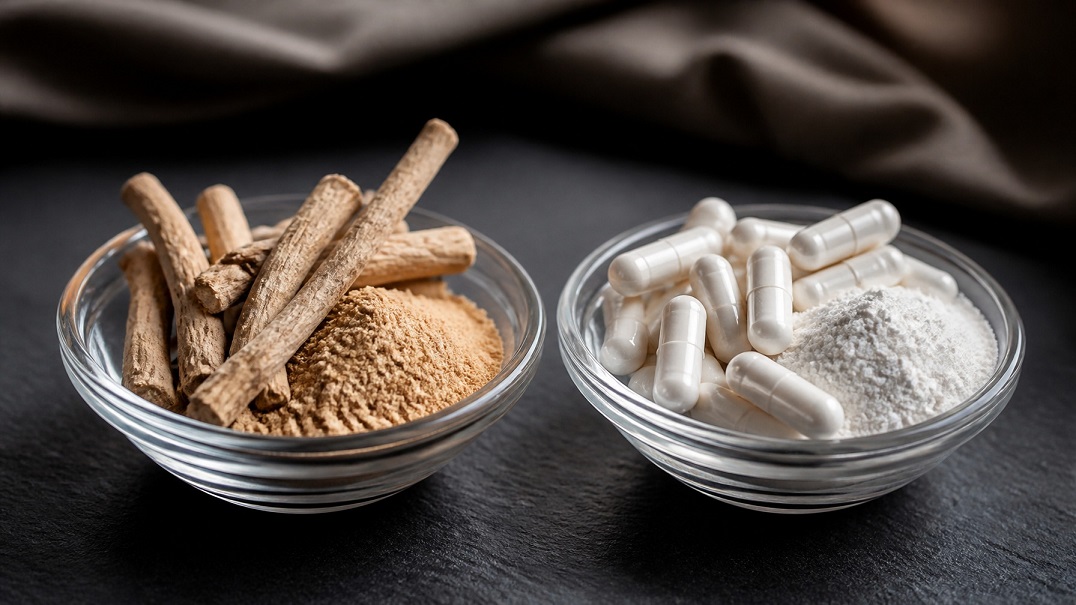
D-aspartic acid and ashwagandha show up together in almost every testosterone-support formula, usually presented as a matched pair of “proven” ingredients. They’re not equally proven. One has a research base that’s held up reasonably well as more trials have come in. The other looked more promising a decade ago than it does today, once you account for who the studies were actually done on. Here’s what the evidence for each actually says.
D-Aspartic Acid: The Mechanism
D-aspartic acid (DAA) is an amino acid – specifically the “D” form, distinct from the far more common L-aspartic acid – that acts as a signaling molecule in the neuroendocrine system. The proposed mechanism is direct: DAA appears to increase release of gonadotropin-releasing hormone (GnRH) from the hypothalamus and luteinizing hormone (LH) from the pituitary, and acts directly on testicular Leydig cells to stimulate testosterone synthesis. This is a well-established mechanism in animal and cell-culture studies. The gap, and it’s an important one, is that most of that mechanistic evidence comes from those animal and in vitro models – the human evidence is a smaller, separate body of research, and it tells a more complicated story.
D-Aspartic Acid: What the Human Evidence Actually Shows
Where DAA looks good: studies in untrained or previously low-testosterone men have shown real increases in testosterone over short periods, often around two weeks.
Where it falls short: multiple randomized controlled trials in resistance-trained men found no significant change in testosterone with DAA supplementation. One notable three-month, randomized, double-blind, placebo-controlled trial in resistance-trained men found that testosterone did not increase at all over the study period in the DAA group relative to placebo.
One proposed explanation is a negative feedback loop: continued DAA intake appears to upregulate the enzyme that breaks it down (D-aspartate oxidase), which may explain why an early bump in testosterone doesn’t hold up with sustained use.
Zooming out, a systematic review of the human research on D-aspartic acid and testosterone – as distinct from the much larger animal literature – found only a handful of qualifying human studies, described the results across them as inconsistent, and explicitly called for larger, better-designed trials. That’s a notably more cautious conclusion than the confidence with which DAA is usually marketed.
Bottom line: DAA’s best-supported use case is short-term supplementation in men who are untrained and/or already testosterone-deficient – not the “take it daily, indefinitely, for general support” framing it’s usually sold with.
Ashwagandha: The Mechanism
Ashwagandha (Withania somnifera) is an adaptogenic herb with a long history in Ayurvedic medicine; modern research is mostly built around standardized root extracts, with KSM-66 among the most-studied. Its proposed mechanism is more indirect than DAA’s: ashwagandha appears to reduce cortisol through modulation of the hypothalamic-pituitary-adrenal (HPA) axis. Because cortisol and testosterone have an inverse relationship under chronic stress, lowering cortisol is the primary proposed pathway to supporting testosterone – a less direct mechanism than DAA’s, but one with a clearer, better-replicated evidence trail behind the cortisol-lowering part specifically.
Ashwagandha: What the Human Evidence Actually Shows
A systematic review of herbal ingredients and testosterone that evaluated a wide range of herbs – including Asian ginseng, maca, and Rhodiola – found that only two, ashwagandha and fenugreek, had a consistent, positive effect on testosterone concentrations across the randomized controlled trials reviewed. That’s a meaningfully different starting point than DAA’s evidence base: fewer total herbs “passed,” but the ones that did showed a more repeatable signal.
More recent trials have added to that picture. A randomized, double-blind, placebo-controlled trial in resistance-trained men using 300 mg of KSM-66 ashwagandha extract twice daily (600 mg/day total) over 8 weeks found significantly greater increases in testosterone, strength, and muscle size compared to placebo – notably, this is in the same population where DAA’s evidence falls short, not a separate, easier-to-impress group.
Worth including for balance: not every ashwagandha trial finds a significant testosterone effect. A well-designed 60-day randomized, double-blind, placebo-controlled trial found testosterone increased in the ashwagandha group but the change wasn’t statistically significant compared to placebo – even though cortisol and DHEA-S changes were significant. So “consistent” doesn’t mean “universal.” It does mean a meaningfully more repeatable pattern than DAA’s.
Bottom line: the evidence supports ashwagandha as a reasonable ingredient for daily, ongoing use, with the strongest and most consistent signal on stress and cortisol markers, and a fairly consistent – if not perfectly unanimous – secondary signal on testosterone itself.
Head-to-Head Comparison
| D-Aspartic Acid | Ashwagandha | |
|---|---|---|
| Proposed mechanism | Direct stimulation of LH and testosterone signaling | Indirect, via cortisol reduction |
| Best-supported use case | Short-term use in untrained or low-T men | Daily, ongoing use across a broader population |
| Effect in trained/active men | Little to no effect; possible decrease with prolonged use | Positive effects shown, including alongside resistance training |
| Consistency of human trials | Sparse and inconsistent | More consistent, though not unanimous |
| Typical studied dose | 2,000–3,000 mg/day | 300–600 mg/day (standardized extract) |
| Time to effect in studies | ~2 weeks in short trials | ~8 weeks |
Does the Dose in Most Formulas Match the Research?
This is worth checking for any product, and it’s rarely flattering: a lot of testosterone-support formulas include an ingredient at a fraction of the dose used in the studies behind it – enough to list it on the label, not enough to plausibly reproduce the studied effect.
It’s worth pointing out here that Testosil’s doses of these two ingredients land squarely in the ranges actually used in the research above: 2,000 mg of D-aspartic acid, right in the 2,000–3,000 mg range used in the studies that found an effect, and 600 mg of KSM-66 ashwagandha – the exact 300 mg twice-daily dose used in the resistance-trained-men trial cited above. That’s not something that can be said about every ingredient in every formula you’ll look at, so it seems worth calling out. (For the complete rundown of doses across the whole formula, see our full ingredient-by-ingredient breakdown of Testosil.)
Who Each Ingredient Is Actually a Reasonable Fit For
D-aspartic acid is most plausibly useful for:
- Men with confirmed low-normal testosterone, especially if under-training or largely sedentary
- Short-term use rather than indefinite daily supplementation
- Not a strong pick specifically for men who are already resistance-training consistently – the population where it’s shown the weakest results
Ashwagandha is most plausibly useful for:
- Men whose symptoms are plausibly stress- or cortisol-linked
- Daily, ongoing use rather than a short course
- A broader population generally, including resistance-trained men
Frequently Asked Questions
Should you take D-aspartic acid and ashwagandha together, or just one?
They work through different, non-competing mechanisms, so combining them isn’t contradictory. That said, DAA’s added value specifically for men who are already resistance-training regularly is the weaker part of that combination – its evidence is strongest for untrained or low-testosterone men, while ashwagandha’s evidence holds up across a broader group.
Does more D-aspartic acid work better than less?
There’s no clear dose-response relationship established in human trials. Higher doses haven’t shown reliably better outcomes, particularly in resistance-trained men, where even standard doses have struggled to show an effect over longer use.
How long should you take ashwagandha before expecting results?
Most of the positive trials used at least 8 weeks of consistent daily use. Shorter trials are less likely to show a measurable effect, so this isn’t an ingredient where a week or two is a fair test.
Bottom Line
These two ingredients don’t deserve equal billing, even though they’re marketed as a matched pair. Ashwagandha has the more consistent, better-replicated evidence behind it, including in the exact population – resistance-trained men – where D-aspartic acid’s evidence is weakest. DAA’s evidence is real, but narrower than its popularity suggests, and it’s best suited to a more specific group of men than most marketing implies. That’s not a reason to write it off entirely – it’s a reason to have realistic expectations about who it’s actually likely to help.