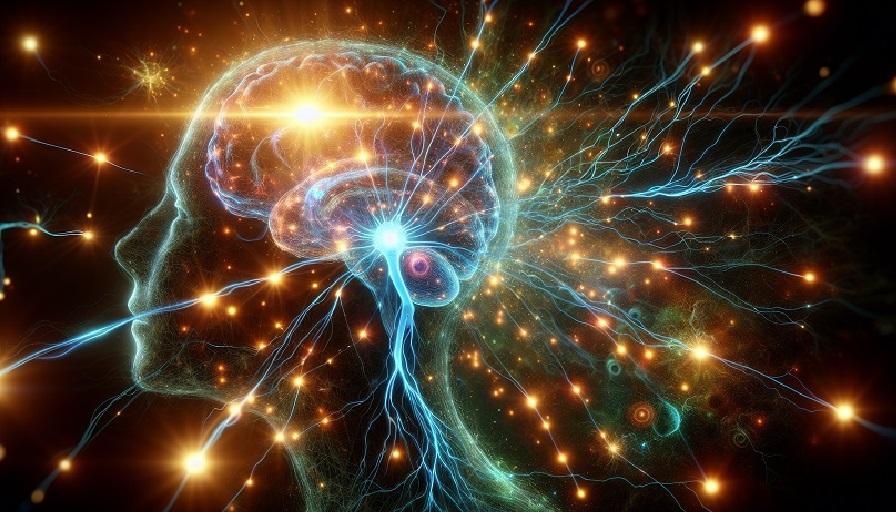
Close your eyes and picture a red apple. Now rotate it slowly. Now replace it with something you have never seen: a transparent apple filled with tiny golden fish. The fact that you can do any of this, conjuring, manipulating, and inventing visual imagery inside a skull with no light source whatsoever, is one of the more remarkable things the brain does. And it tells us something important about where creative genius lives.
The visual system is the most extensively mapped sensory system in the human brain, occupying roughly thirty percent of the cortex. But the visual cortex is far more than a passive receiver of light signals. It is an active generator of imagery, and understanding how it works unlocks a richer appreciation of artistic creativity, mental visualization, and the neuroscience of imagination itself.
Seeing Is Constructing
Most people experience vision as something that simply happens: light enters the eye, the brain registers what is there. The reality is considerably more active. Only a fraction of visual experience comes directly from the eyes. The rest, an estimated eighty percent or more, is generated by the brain itself, filling in gaps, applying prior knowledge, constructing a coherent scene from incomplete data.
Vision, in other words, is a creative act. The brain you use to paint a canvas or write a vivid scene is the same brain that constructs your moment-to-moment visual experience of the world. The relationship between perception and imagination is not a clean boundary. It is a continuum.
Top-Down and Bottom-Up Processing
Visual neuroscientists distinguish between bottom-up processing, in which raw sensory data travels from the eyes upward through visual cortex hierarchies, and top-down processing, in which expectations, memories, and higher cognitive functions reach downward to shape what is perceived. Artists and highly visual creative thinkers tend to show unusually flexible interplay between these two directions, capable of both acute perceptual observation and rich imaginative projection.
When a skilled illustrator looks at a face and sees not just features but emotional history, or when a novelist describes a room in such precise sensory detail that readers feel they have been there, both are deploying this top-down capacity in ways that go beyond ordinary perception. Creative vision is, at least in part, trained perception.
Mental Imagery and the Visual Cortex
When you visualize something, whether an apple, a remembered landscape, or an entirely invented scene, the primary visual cortex activates in patterns strikingly similar to those produced by actual vision. The brain is, in a very literal sense, seeing what it imagines. This is not a metaphor. Neuroimaging studies confirm that mental imagery and visual perception share substantial neural architecture.

Aphantasia: When the Mind’s Eye Goes Dark
Not everyone visualizes with equal vividness. Approximately two to four percent of the population have aphantasia, a condition in which voluntary mental imagery is absent or severely reduced. Individuals with aphantasia cannot picture a red apple when asked to. The mind’s eye, for them, is dark.
Fascinatingly, some people with aphantasia are highly accomplished visual artists, navigating creativity through other cognitive routes including pattern memory, procedural knowledge, and conceptual reasoning rather than vivid mental imagery. Their existence reminds us that creative genius is rarely reducible to a single neural mechanism. The brain finds routes around its own constraints with impressive ingenuity.
Hyperphantasia and the Vividly Imaging Brain
At the opposite end of the spectrum is hyperphantasia, in which mental imagery is experienced with extraordinary vividness and detail, sometimes approaching the quality of actual perception. Many writers, painters, and filmmakers report imagery of this intensity, describing characters and scenes they visualize as clearly as anything in the physical world. Nikola Tesla famously claimed to visualize and mentally test his inventions in complete three-dimensional detail before committing a single design to paper.
Whether or not this extreme of mental visualization is necessary for creative achievement, the underlying capacity to hold and manipulate rich internal imagery is a meaningful component of many forms of creative genius, and one that appears to be trainable to a meaningful degree.
Visual Creativity and the Brain’s Imagination Network
Creative visual imagination is not purely a product of the visual cortex. It emerges from a collaboration between the visual system and the brain’s broader imagination network, centered on the default mode network, which provides narrative context and associative richness, and the executive control network, which directs and shapes what is imagined toward intentional creative ends.
When a painter decides to represent grief as a particular quality of light, or a filmmaker uses negative space to communicate isolation, they are orchestrating this collaboration deliberately: drawing on visual memory, emotional association, aesthetic judgment, and imaginative projection all at once. This is what makes visual creativity so neurologically rich and so difficult to reduce to any single cognitive process.
Training the Visual Brain
Sustained visual art practice produces measurable changes in the brain. Studies of trained artists show altered activity patterns in visual processing regions, with greater engagement of areas associated with symbolic meaning and emotional resonance alongside purely perceptual processing. The artist’s brain does not just see more accurately. It sees more meaningfully.
Drawing practice in particular appears to train what researchers call “slow looking,” the ability to sustain attention on a visual subject long enough to observe what is actually there rather than what the brain expects to find. This runs counter to the brain’s natural efficiency drive and requires deliberate practice, but the cognitive gains extend beyond art-making into general observational acuity and attention to detail.
Supporting the Visual Creative Brain
The visual cortex is metabolically one of the most demanding regions of the brain, and the imaginative work it performs during creative visualization adds further demands on top of ordinary sensory processing. Supporting this system nutritionally is not an afterthought for visually creative people. It is directly relevant to the quality of the cognitive work they do.
DHA, the omega-3 fatty acid most concentrated in brain tissue, is especially abundant in the retina and visual cortex. Adequate DHA is critical for the membrane fluidity that efficient visual processing and neural communication require. Lion’s Mane mushroom, through its support of nerve growth factor, encourages the maintenance of the neural connectivity that rich visual imagination depends on. Bacopa monnieri supports the working memory that holds and manipulates complex visual imagery during creative tasks.
Citicoline enhances the synthesis of phosphatidylcholine, a key component of neural membranes throughout the visual system. For artists, designers, filmmakers, and anyone whose creative work depends heavily on visual imagination, a brain supplement that supports these functions may help maintain the neural infrastructure that visual creativity runs on. Speak with a healthcare provider about what makes sense for your needs.