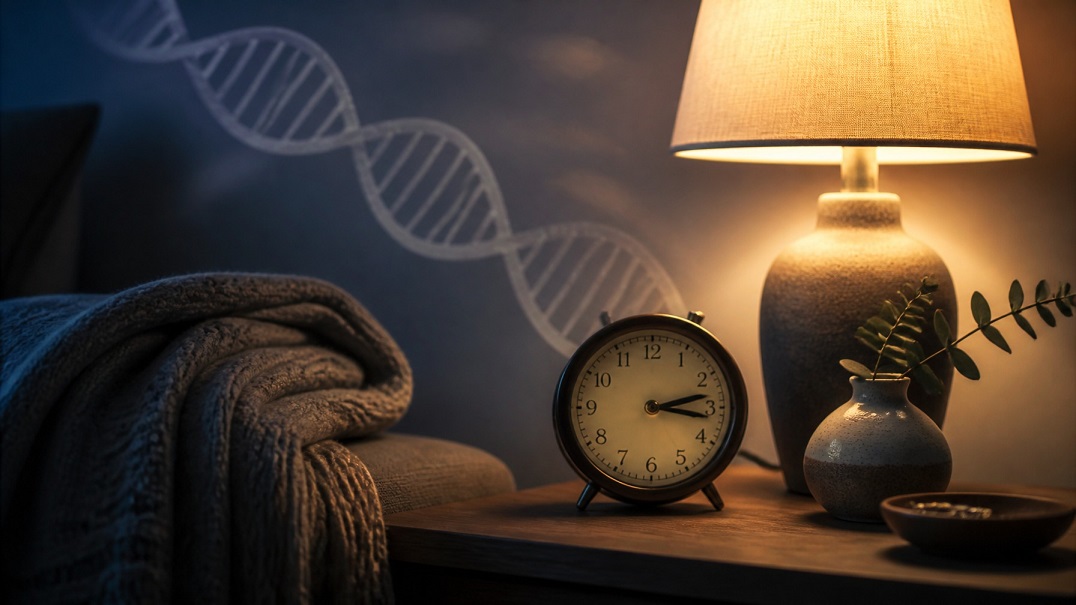
I’ve described myself as a light sleeper for so long that it stopped feeling like a claim and started feeling like a fact about me, the same way I’d mention my height. A car door slams outside and I’m awake. The heat kicks on and I’m awake. Somewhere around 3 a.m., most nights, I’m awake for no reason at all, and it takes an hour or more to fall back asleep.
For years I treated this as just part of my personality, something to work around rather than understand. Blackout curtains, a white noise machine, cutting caffeine after noon. Each change helped a little. None of them touched the 3 a.m. wake-up, which kept happening with the reliability of an alarm clock nobody set.
This is one version of a pattern I hear about constantly, the details changing but the shape holding steady. Someone assumes their sleep is simply fragile by nature, tries every environmental fix available, and still wakes at the same point most nights. Mine eventually led to a DNA test that explained a lot more than “light sleeper” ever did.
The 3 A.M. Wake-Up I Couldn’t Explain
It wasn’t dramatic. I’d fall asleep easily enough, usually within twenty minutes of getting into bed. Then, somewhere between 2:30 and 3:30, I’d surface, fully alert, mind already running through the next day. Sometimes I’d drift back off within a few minutes. Other nights I’d lie there for over an hour, increasingly frustrated, watching the clock creep toward a time that made going back to sleep feel pointless.
What made it strange was the consistency. Vacations, weekends, stressful weeks, calm weeks, it didn’t seem to matter. The wake-up showed up almost regardless of context, which should have been a clue that something more structural was going on rather than something tied to a particular day’s stress level.
I assumed it was stress at first, then age, then too much screen time before bed. I tried explanations in roughly that order over several years, and made changes to match each one. The room got darker. The phone got banished to another room. I started reading instead of scrolling. The wake-up persisted through every version of my supposedly improved routine.
Fixing My Sleep Environment Didn’t Fix My Sleep
By the time I’d optimized nearly everything a sleep article could suggest, cool room, consistent bedtime, no caffeine after noon, minimal light, I was waking at 3 a.m. about as often as when I started. That was the part that genuinely confused me. Sleep hygiene advice is usually framed as the fix, and I’d followed most of it seriously enough to expect results.
What I didn’t consider, because I didn’t know to look for it, was that the timing itself might be meaningful. Not random middle-of-the-night wakefulness, but a specific, repeatable point tied to something happening internally rather than in my bedroom. I’d spent years treating the symptom as noise instead of asking why it always landed around the same hour.

What My Genes Actually Showed
A DNA test wasn’t something I sought out for sleep specifically. It came bundled into a broader health report a coworker had mentioned, and I mostly expected it to confirm what I already assumed, that I was just a light sleeper and that was that. I almost skipped the sleep section entirely, figuring I already knew the conclusion. Instead, one section on serotonin and melatonin production laid out something I’d never considered.
How Serotonin Becomes Melatonin, and Why the Timing Can Shift
Melatonin, the hormone that helps regulate sleep timing, is made from serotonin through a conversion process that depends on several genes working together across the day. The report explained that variations in these genes can affect not just how much melatonin gets produced, but when the body’s internal clock schedules its release and how quickly it clears afterward. For some people, that means a normal amount of melatonin arriving on a slightly different schedule than the textbook eight-hour sleep cycle assumes, which can show up as a natural dip in the middle of the night rather than a smooth stretch through to morning.
Reading that felt like being handed a timestamp for something I’d only ever experienced as a mystery. It wasn’t that my sleep was fragile in some vague, personality-driven way. It was that my body’s melatonin timing may run on a slightly different internal schedule, one where a mid-night dip was a plausible, explainable event rather than a random disruption.
Why Environmental Fixes Could Only Do So Much
This also explained why the sleep hygiene changes had helped a little but never solved it. A darker room and no screens can support good sleep, but they can’t reset an internal hormone schedule on their own. I’d been treating the environment as the whole equation when it was really only ever half of it.
What Actually Changed
Nothing about this made the 3 a.m. wake-ups vanish overnight, and I want to be honest about that too. What changed was how I responded to them. Instead of lying there frustrated, treating each wake-up as a failure of my routine, I started treating it as an expected dip, something my body does, and stopped fighting it with phone-checking or clock-watching. That shift alone shortened how long it took me to fall back asleep, probably because I wasn’t adding stress hormones on top of an already awake brain.
I also stopped chasing every new sleep gadget or supplement hoping for a total fix. Understanding the likely mechanism gave me a much clearer sense of what was worth trying, gentle, timing-focused adjustments, and what wasn’t going to move the needle no matter how good the reviews looked.

What I’d Tell Someone Who’s Been There
If you wake at close to the same time most nights, regardless of how carefully you’ve optimized your bedroom, that consistency is worth paying attention to rather than writing off as bad luck. Bodies regulate sleep hormones on genuinely different internal schedules, and no amount of blackout curtains changes the underlying biology.
That doesn’t mean genetics explains every sleep problem, or that it’s a reason to skip the basics that still matter, consistent bedtimes, limited late caffeine, a dark room. But understanding your own internal timing, rather than assuming you’re simply a light sleeper and leaving it at that, can turn years of frustration into something a lot more workable.
I still wake up most nights around three. I just don’t spend that hour anymore wondering what’s wrong with me.
Questions People Ask After a Story Like This
Is this normal, or was this case unusual?
Waking at a consistent point in the night is a common experience, and genetic variation in melatonin production and timing is a well-documented reason it happens more to some people than others. It’s more widespread than the general “light sleeper” label usually implies.
Does this mean sleep problems are “just genetic”?
No. Genetics can influence melatonin timing and production, but stress, screen exposure, room temperature, and daily routine all still play a real role. Genetics is better understood as one factor shaping your baseline, not the full explanation on its own.
How would I know if something similar applies to me?
A pattern worth noticing is consistency, waking at close to the same time most nights even after you’ve addressed the usual sleep hygiene basics. That kind of repeatable timing often points toward something internal rather than purely environmental.
What would a next step even look like?
For some people, that’s a conversation with a doctor about sleep patterns, especially if wake-ups are frequent or significantly affecting daily life. For others, it starts with understanding the genetic factors behind melatonin timing, which can reframe a frustrating pattern as something explainable rather than random.